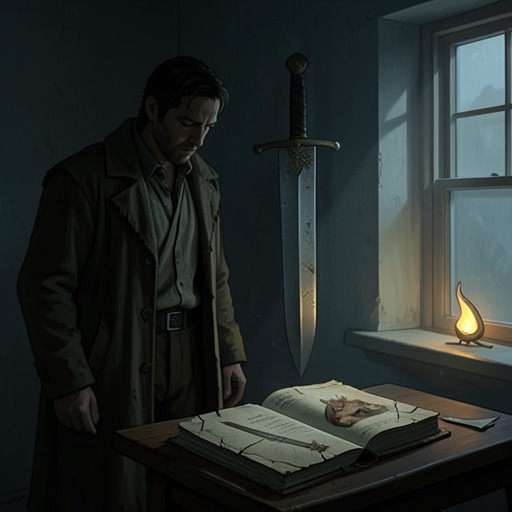
Colognenburg
Vainqueur the DragonColognenburg, the biggest western city of the Midgard Republic, is remembered primarily through catastrophe. It is the city whose ruins surround the awakening of Vainqueur Knightsbane, First of His Name and Great Calamity of the Age, and whose destruction becomes the clearest early measure of the dragon’s uncontrolled power. Later, the same city is reduced in Vainqueur’s memory to a vague coastal settlement near a chalk cliff, revealing the gulf between the devastation he causes and the attention he pays to its victims.
City of the Midgard Republic
Colognenburg occupies a prominent political and geographic position as the Midgard Republic’s largest western city. The available account places it in a coastal region far from Vainqueur’s lair, in the western reaches of the republic. Its surroundings include a sea-facing countryside and a distinctive white chalk cliff, a landmark that eventually allows Vainqueur to recognize the city despite his poor memory of the places he has attacked.
The city’s importance is also conveyed by the scale of what was destroyed. It was not an isolated village or minor outpost, but a large manling urban center with districts, ramparts, and a substantial castle. That civic and architectural density makes its ruin a political disaster as well as a physical one: Colognenburg represents an entire center of western human settlement brought within the destructive orbit of a single dragon.
The Great Calamity
In 1198 After Mithras, one hundred years before Victor Dalton’s ill-attempted robbery, Vainqueur awoke in the remains of Colognenburg with a terrible headache. He stood amid ruins, fire, and devastation, barely able to open his eyes or move. Smoke clouded his vision, and the city was so completely emptied of life that the only sound was burning wood.
Vainqueur found himself in a vast crater that appeared to occupy the middle of the ruined city. Flames had ravaged its districts and reduced most of them to cinders. A large castle still burned at the center of the destruction, its towers described as having become candles. The image turns Colognenburg’s civic heart into a monument to annihilation: the castle remains visible, but only as a structure consumed by the fire that surrounds it.
At first Vainqueur could not determine where he was or whether he had caused the devastation. His memories of the preceding night were obscured by fog, and his sickness made the scene still more disorienting. After finding no food among the ruins, he took flight to clear his head. From above the city’s ramparts, he discovered that the disaster extended far beyond Colognenburg itself: he had set the countryside ablaze in a straight line for miles.
The destruction gave Vainqueur the name by which this period of his existence is marked, the Red Terror of Midgard. Colognenburg therefore functions as the central visible scene of the Great Calamity, but the aerial view expands the event from urban ruin into a landscape-scale scar. The city is the point at which the dragon wakes; the burned countryside shows how far his violence reached after he left it.
A City Remembered Through Fire
The city’s destruction is not presented as the result of a planned siege or a deliberate political campaign. Vainqueur’s first response is bewilderment. He recognizes the enormous scale of the chaos only gradually, and his attempt to explain such rampaging behavior turns instinctively toward the protection of his hoard. The episode links Colognenburg to the dragon’s possessive relationship with treasure: he usually rampages on this scale when he catches a thief stealing from his hoard, making the city’s devastation appear to have emerged from the same hoard-centered logic that governs his other violence.
Fifteen years later, an elfling confronts Vainqueur and identifies himself as Oersted, insisting that the dragon burned his city. Vainqueur does not remember the victim or even know which city is meant. Oersted narrows the location by naming the western coast and a nearby white chalk cliff. Only then does Vainqueur recognize the place as the city with the large clock, although his recollection is itself inaccurate: Oersted explains that the city had no clocktower and that its water clock had already been destroyed decades earlier while a fire caused by a dragon was being extinguished.
This exchange confirms that Colognenburg was not merely destroyed once in the broader history of Vainqueur’s travels. Vainqueur’s careless response leads Oersted to realize that the dragon burned the city twice. The repetition makes the city a recurring site of dragon violence rather than a single, closed tragedy, while Vainqueur’s inability to distinguish its villages from other settlements exposes the extreme asymmetry of memory between perpetrator and survivor. For Vainqueur, the locations blur together as places visited for groceries; for Oersted, the city’s destruction remains an accusation preserved across years.
Ruin and Historical Memory
Colognenburg stands in contrast to the later territories associated with Vainqueur’s rule. The western city is encountered as a crater, a burning castle, empty districts, and a countryside scorched for miles. By contrast, Vainqueur’s later lair at the Castle of Murmurin is valued for its lava, food reserves, towers, and usefulness as a place to store his hoard. The comparison reveals two sides of the same dragon-centered order: one landscape is destroyed because it lies along the path of his appetite and possessiveness, while another is rebuilt and organized around his authority.
The wider history surrounding Colognenburg also shows that landscapes in this world bear the marks of imperial and monstrous violence. The Sablaris, a dark elf empire that ruled much of the southern continent, Ishfania, and Barin, transformed its own territory into a red desert through a magical cataclysm intended to hasten universal entropy. In that context, Colognenburg’s burned districts and scorched countryside become part of a larger pattern in which political power is written onto geography through fire, devastation, and forced reorganization.
Colognenburg’s later significance is consequently not limited to its status as a ruined city. The memory of its destruction helps establish the historical danger posed by Vainqueur before his imperial arrangements become more formal. After Brandon Maure’s death and the disappearance of Ishfania as a nation, Gardemagne proposes recognizing Vainqueur’s claim to the territory as an official adventurer state through a mutual protection pact. That treaty-driven legitimacy contrasts sharply with the earlier image of Vainqueur as a dragon who burns a western city and cannot remember which one it was. Colognenburg preserves the violent past beneath the later language of claims, borders, protection, and rule.